Every founder asks this question before they ask anything else: "How much should I actually be spending on Meta Ads?" And every generic answer — 10% of revenue, $50/day to start, "just test and see" — skips the variables that actually determine the right number for your brand.
The honest answer is that your budget should be a function of three things: your stage (do you have a proven winner yet), your margins (can you afford to test), and your goal (are you testing or scaling). Here's how we actually set budgets for the Shopify accounts we manage.
Budget by Revenue Stage
This is the framework we start every new account conversation with. It's not exact science, but it's a far better starting point than a flat percentage.
| Stage | Monthly Revenue | Suggested Meta Ads Budget | Primary Goal |
|---|---|---|---|
| Pre-scale | $0-$10K/mo | $1,500-$3,000/mo | Find one profitable campaign |
| Growth | $10K-$50K/mo | $3,000-$12,000/mo | Build TOF/MOF/BOF structure, scale winners |
| Scale | $50K+/mo | $12,000-$40,000+/mo | Multiple parallel funnels, new markets |
Notice these are ranges, not percentages of revenue. A brand doing $15K/month with 65% margins can afford to spend more aggressively than a brand doing $15K/month with 25% margins — even though their revenue is identical.
Why "10% of Revenue" Falls Apart
The 10% rule assumes every brand has the same margin structure and the same stage of account maturity. In reality, a brand new to Meta Ads still needs enough budget to get through creative testing regardless of what 10% of their (small) revenue works out to — otherwise they never generate enough data to find a winner in the first place.
Key Takeaway
Budget should be set by what you need to learn or scale next — not by a fixed percentage of revenue that ignores your margin and testing stage.
Testing Budget vs. Scaling Budget
Within whatever total budget you land on, the split between testing new creative/audiences and scaling proven winners matters as much as the total number.
- New accounts (no proven winner yet): 60-70% testing, 30-40% scaling whatever early signal you have. You need the data more than you need to protect a "winner" you're not fully sure about yet.
- Established accounts (proven winners exist): 20-30% ongoing testing, 70-80% scaling. Protect your margin by not over-testing once you have a reliable engine — but never drop testing to zero, or you'll have nothing ready when your current winner fatigues.
This is exactly what a real account transition looks like. Below is a real testing campaign from one of our Shopify accounts — a $89.99 test spend on 3 purchases — and the same account structure two weeks later once the winning combination was identified and scaled.
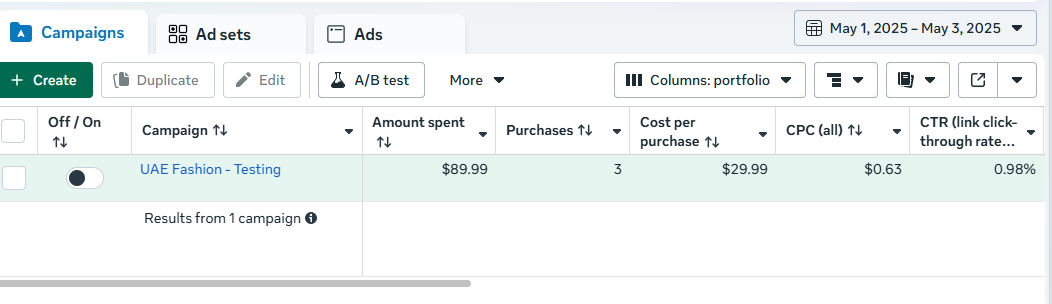
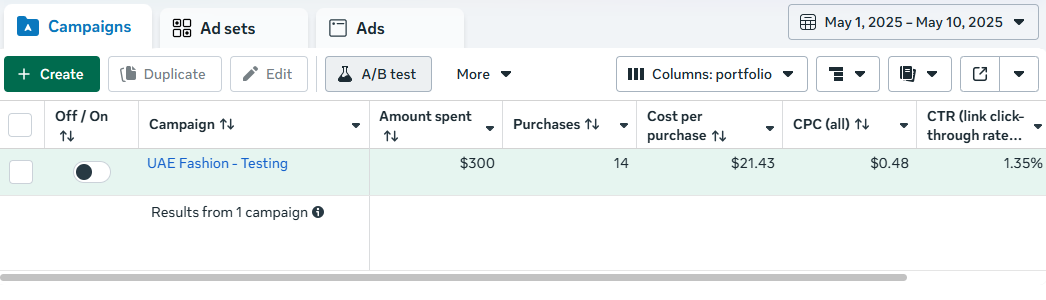
Notice CPA improved as budget scaled here — that's not automatic. It only happens when you scale a genuinely proven winner incrementally, which is why the testing phase matters so much before you commit real budget.
Scaling a winner the wrong way is the fastest way to spike CPA.
See our incremental scaling framework →Signs Your Budget Is Too Low
- Campaigns never exit Meta's "learning phase" because they don't generate enough weekly conversions (Meta generally needs ~50 conversion events per week per ad set to optimize reliably).
- You can't run more than 1-2 creative concepts at a time, which means you're not really testing — you're guessing serially.
- You're making "Meta Ads doesn't work" conclusions off of $200-$300 total spend, which isn't enough data to conclude anything.
Signs Your Budget Is Too High Too Fast
- You increased budget more than 30% in a single change and CPA spiked immediately afterward.
- You're spending on 10+ creative concepts simultaneously and none of them have enough individual spend to reach a real conclusion.
- Your cash flow is stressed by ad spend before you've validated repeat purchase rate or actual LTV — meaning you're funding growth you can't yet prove is profitable.
Seasonal Budget Planning
Don't set one budget number and leave it static year-round. Build in planned increases 3-4 weeks ahead of major sales periods (BFCM, Ramadan/Eid for UAE-based brands, end-of-financial-year sales in Australia) so Meta's algorithm has time to recalibrate before the volume spike — not during it. A sudden 3x budget jump on the first day of a sale is exactly the scenario the 20-30% scaling rule exists to prevent.
Frequently Asked Questions
How much should a Shopify brand spend on Meta Ads per month?
It depends on stage, not a fixed percentage. Pre-$10K/month brands should budget $1,500-$3,000/month purely for testing. $10K-$50K/month brands typically spend $3,000-$12,000/month. Brands past $50K/month usually run $12,000-$40,000+/month once a profitable structure is proven.
Is 10% of revenue a good rule for Meta Ads budget?
It's a starting heuristic at best. It ignores your margins, AOV, and whether your account is still in a testing phase or already has proven winners to scale. A 20%-margin brand and a 60%-margin brand shouldn't be spending the same percentage of revenue on ads.
How much of my Meta Ads budget should go to testing vs scaling?
In an account with proven winners, 70-80% of budget should go to scaling what works and 20-30% to ongoing creative and audience testing. In a brand-new account, that ratio flips — closer to 60-70% testing until you have at least one reliable winning campaign.
What happens if my Meta Ads budget is too low to get results?
Below roughly $1,000-$1,500/month, most Shopify accounts can't generate enough data for Meta's algorithm to exit the learning phase or for you to reach statistically meaningful test results. You end up making decisions off too little data, which usually looks like "Meta Ads doesn't work for us" when the real issue is insufficient budget to learn anything.
The Bottom Line
The right Meta Ads budget isn't a percentage you copy from a blog post — it's a number derived from your margins, your current stage, and what you actually need to learn or scale next. Get the stage and split right, and the total number becomes much easier to defend to yourself and your finance spreadsheet.