Most of the content about Meta Ads assumes you're selling a physical product through a Shopify checkout. But a huge share of the businesses we talk to — agencies, consultants, B2B service providers, professional practices — don't have a "buy now" button. They have a calendar. Their conversion event isn't a purchase, it's a booked call.
The mechanics are different, but Meta Ads works just as well for this — arguably better in some cases, since you're not competing with checkout friction, shipping costs, or cart abandonment. Here's how we structure lead generation campaigns for service and B2B clients.
Messaging Campaigns vs. Lead Forms: Pick the Right Objective
Meta gives you two primary paths for lead generation, and they behave very differently.
| Objective | How It Works | Best For |
|---|---|---|
| Messaging (WhatsApp/Messenger) | Ad opens a direct conversation in-platform | Higher-touch services, immediate qualification through conversation |
| Instant Forms / Lead Ads | Prospect submits contact details without leaving the app | Higher volume, faster capture, works well with pre-qualifying questions |
| Landing Page Form | Ad sends traffic to your own site to fill out a form | When you need more context/trust-building before someone submits details |
Messaging campaigns tend to produce higher-intent conversations — a prospect has to actively type and engage, which filters out casual browsers. Lead forms produce higher volume but often lower average intent, since submitting a phone number takes seconds and requires far less commitment.
Neither is universally "better." The right choice depends on your sales process: if you have a team ready to respond instantly to conversations, messaging campaigns convert extremely well. If your team works better calling a list of numbers on a schedule, lead forms with strong pre-qualifying questions are the better fit.
Pre-Qualifying at the Ad Level
The biggest mistake we see in lead gen campaigns: capturing a name and phone number and nothing else. That produces a list you then have to qualify manually, one call at a time — slow, and it burns sales team hours on leads that were never a fit.
Add 2-3 qualifying questions directly into your Instant Form or messaging flow:
- Budget/timeline signal: "What's your approximate monthly budget for this?" or "Are you looking to start in the next 30 days?"
- Fit signal: A question that filters for your ideal customer profile — company size, current situation, or specific need.
- Intent signal: "What's the main thing you're hoping to solve?" — even a short free-text answer tells you far more than a name and number alone.
Yes, this adds friction and will reduce raw lead volume. That's the point — you're trading volume for a list your sales team can actually work efficiently.
Key Takeaway
A lower volume of pre-qualified leads that convert to calls at 30% beats a higher volume of unqualified leads that convert at 5%. Optimize for booked calls, not raw lead count.
Real Examples: Messaging in Australia, Lead Forms in Canada
Here's what this looks like in practice across two different markets and two different lead formats.
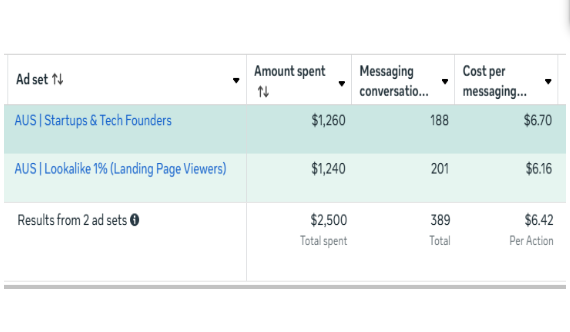
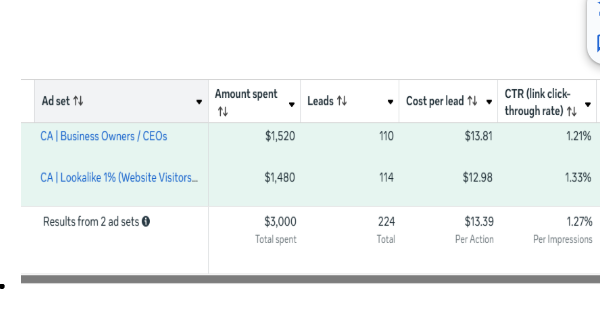
Notice the cost difference: the messaging campaign produces a lower cost-per-action, but that action is "started a conversation," not "submitted verified contact details." Both are valid — but they need to be measured and staffed differently. A messaging campaign generating hundreds of conversations needs a team ready to respond in real time, or that lower cost-per-action becomes wasted opportunity.
Building the audience layer behind campaigns like these matters as much as the objective.
See our funnel and scaling framework →The 5-Minute Follow-Up Rule
This is the single highest-leverage, lowest-cost fix most lead gen campaigns need — and it has nothing to do with the ad account.
Response speed is one of the strongest predictors of lead-to-call conversion. A lead that gets a reply within 5 minutes converts to a booked call at a dramatically higher rate than one that waits an hour. Past that window, even a genuinely qualified prospect starts to feel ignored, and interest cools fast.
If your sales process can't guarantee a 5-minute response during business hours, an automated first-touch message (even a simple "Thanks — when's good for a quick call?") buys you time without losing the moment of highest intent.
Tracking Cost Per Qualified Conversation, Not Just Cost Per Lead
Raw cost per lead is a vanity-adjacent metric if you're not also tracking what happens after the lead comes in. Set up a simple tagging system in your CRM — qualified vs. unqualified, booked vs. no-show, closed vs. lost — and feed that back into which ad sets and creative are actually producing leads worth having, not just leads that are cheap to acquire.
Frequently Asked Questions
Can Meta Ads generate qualified B2B leads, not just eCommerce sales?
Yes. Meta Ads offers dedicated objectives for this — Messages campaigns that open a WhatsApp or Messenger conversation, and Instant Forms/Lead Ads that capture contact details directly in-platform. With proper audience targeting and pre-qualifying questions, these can generate leads that convert to booked calls at a healthy rate.
Should I use a messaging campaign or a lead form for Meta Ads lead generation?
Messaging campaigns (WhatsApp/Messenger) tend to produce higher-intent conversations because the prospect has to actively engage in a back-and-forth. Lead forms are faster to fill out and generate higher volume, but often lower intent, since a phone number takes seconds to submit. Test both — the right choice depends on your sales process and follow-up speed.
What is a good cost per lead for Meta Ads?
It varies heavily by industry and market, but for B2B service businesses in the UAE, Australia, and Canada, cost per qualified lead typically ranges from $10-$30 with proper targeting and pre-qualifying questions in the form. Cost per messaging conversation is usually lower, often $5-$15.
How fast should I follow up with a Meta Ads lead?
Within 5 minutes if at all possible. Response speed is one of the strongest predictors of lead-to-call conversion — studies on lead response time consistently show conversion rates drop sharply after the first 5-10 minutes, and lead quality perception drops even for genuinely qualified prospects who feel ignored.
The Bottom Line
Meta Ads lead generation isn't a lesser version of eCommerce advertising — it's a different discipline that rewards pre-qualification and fast follow-up over raw volume. Get those two things right, and Meta becomes one of the most reliable calendar-filling channels available for service and B2B businesses.